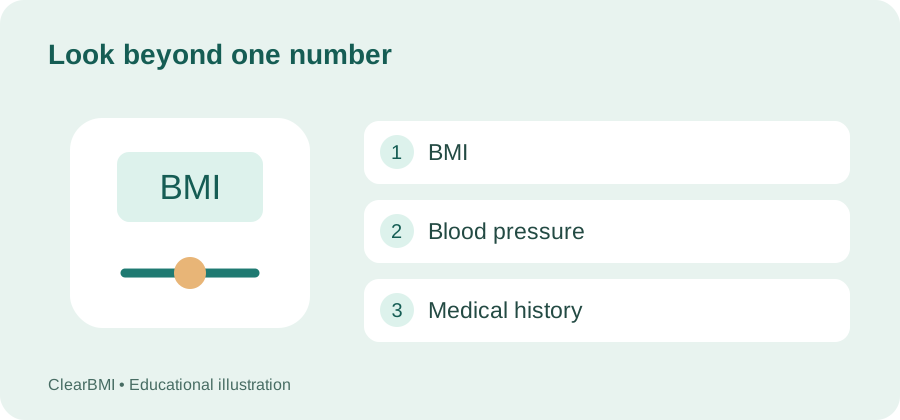
No serious health professional treats BMI as a complete picture of health, and it's worth understanding exactly why — not to dismiss the number, but to use it appropriately alongside other information.
Limitation 1: It can't distinguish muscle from fat
BMI is purely a function of total weight relative to height — it has no way to know whether that weight is muscle, fat, bone, or water. Muscle tissue is denser than fat tissue, so a very muscular person can register a BMI in the "overweight" or "obese" range while carrying relatively little body fat. This is explored in depth in our guide on BMI for athletes and muscular people.
Limitation 2: It ignores where fat is stored
A growing body of research indicates that fat stored around the abdomen (visceral fat) carries different, generally higher, health risk than fat stored elsewhere on the body — even at the same total body fat percentage. Two people with an identical BMI can have meaningfully different health risk profiles based on fat distribution alone. Waist circumference and waist-to-hip ratio, covered in our dedicated guide, help fill this gap.
Limitation 3: It doesn't account for age-related changes
Body composition shifts with age — many people gradually lose muscle mass and gain fat mass even when their weight, and therefore their BMI, stays essentially unchanged. This means the same BMI can represent a different body composition at 30 versus 60. More in our guide on how BMI changes with age.
Limitation 4: One-size-fits-all thresholds
The standard BMI categories were developed primarily from studies on particular populations, and some research suggests the health-risk thresholds may sit somewhat differently for certain ethnic groups. Several countries have adopted adjusted thresholds for their own public health guidance for exactly this reason.
Limitation 5: It says nothing about diet quality, fitness, or metabolic markers
Someone can have a "healthy" BMI while eating poorly and being sedentary, and someone can be in the "overweight" range while being highly active with excellent bloodwork. BMI measures size, not the underlying behaviors or metabolic health that actually drive long-term outcomes.
What to use alongside BMI for a fuller picture
- Waist circumference or waist-to-hip ratio — adds information about fat distribution, not just total mass.
- Body fat percentage — directly estimates the proportion of fat vs. lean mass, addressing BMI's biggest blind spot. See our body fat vs BMI guide.
- Bloodwork (blood pressure, cholesterol, blood sugar) — these markers reflect metabolic health more directly than any size-based measurement.
- How you actually feel and function — energy levels, sleep quality, and physical capability are meaningful indicators that no single number captures.
The bottom line
BMI isn't wrong, exactly — it's just narrow. It was designed as a fast, free, population-level screening tool, and it does that job reasonably well. Problems arise only when it's treated as a complete individual health verdict rather than one useful data point among several. Calculate yours with our free BMI calculator, and read it in the context this article describes.
This article is educational and not a substitute for personalized medical advice.
Two people, the same BMI
Imagine two adults of the same height and weight. One does strength training; the other has recently lost strength after an illness. Their BMI results are identical, although their body composition and care needs may differ. The useful next step is not to decide that BMI is worthless, or that one person is automatically healthy. Ask what question you are trying to answer. A clinician may use symptoms, blood pressure, laboratory results and physical examination to answer questions that a calculator cannot.
Keep reading: