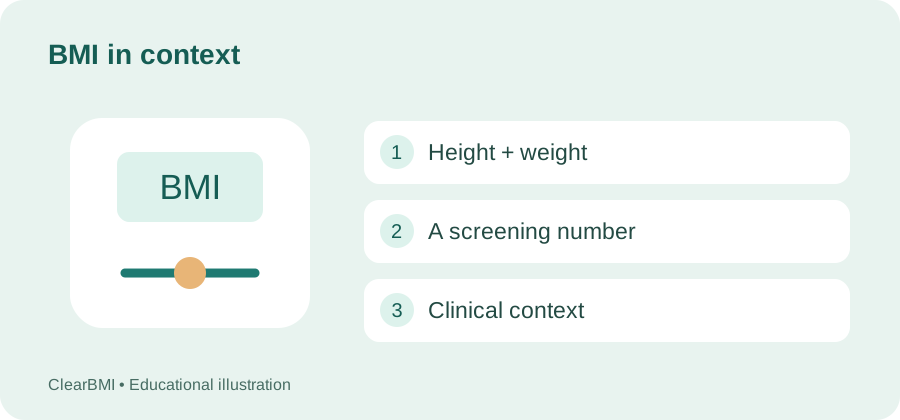
Body Mass Index — BMI — is probably the single most-cited health number that almost nobody can explain past "it's about height and weight." That's roughly correct, but the details matter for understanding what your result actually means.
The formula is simpler than it looks
BMI is calculated as weight in kilograms divided by height in meters squared: BMI = weight (kg) / height (m)². In imperial units, it's weight in pounds divided by height in inches squared, multiplied by 703. That's the entire calculation — no age, sex, activity level, or body composition enters into it at all. Our free BMI calculator does this instantly in either unit system.
Why height gets squared
Weight tends to scale with the square of height across a population — a person twice as tall isn't simply twice as heavy at a proportional build, they're roughly four times as heavy. Squaring height in the formula corrects for this, which is why BMI works reasonably well as a population-level screening tool despite people varying enormously in height.
What BMI was actually designed for
BMI (originally called the Quetelet Index) was developed in the 1830s by a Belgian mathematician studying population averages — not individual diagnosis. It was adopted decades later by public health researchers and insurers because it's cheap, fast, and correlates reasonably well with health risk when averaged across large groups. That population-level origin is the key to understanding both its usefulness and its limits.
What it can reasonably tell you
- A quick, standardized way to categorize weight relative to height (see our BMI categories guide)
- A rough, population-level indicator associated with certain health risks when significantly outside the "healthy weight" range
- A consistent number to track changes over time for the same person, using the same measurement method
What it can't tell you
- How much of your weight is muscle vs. fat. Two people with the same BMI can have very different body compositions — see our guide on BMI for athletes and muscular people.
- Where fat is distributed. Fat carried around the waist is associated with different health risks than fat carried elsewhere, something BMI doesn't distinguish at all. Our waist-to-hip ratio guide covers this.
- Anything about your fitness, diet quality, or metabolic health directly. BMI is a size measurement, not a fitness or nutrition score.
So is it worth using at all?
Yes, with the right expectations. As a fast, free, zero-equipment way to get a general sense of where you stand, BMI is genuinely useful — which is exactly why doctors, researchers and public health bodies still use it as a first-pass screening tool. The mistake is treating a single BMI number as a complete verdict on your health, rather than one data point among several.
Think of BMI the way you'd think of a car's fuel gauge: useful, fast to check, and worth paying attention to — but it won't tell you what's wrong with the engine.
Where to go from here
If you haven't already, calculate your own number with our free BMI calculator, then read our breakdown of what each BMI category actually means to put your result in context.
This article is for general educational purposes and isn't a substitute for personalized medical advice. If you have questions about your weight or health, talk to a doctor or registered dietitian.
A result of 23.5 is a starting point
An adult who weighs 68 kg and measures 1.70 m has a BMI of 68 ÷ (1.70 × 1.70), or about 23.5. This tells you where the height-to-weight relationship falls in the adult categories. It does not tell you whether that person sleeps well, has high blood pressure, or has adequate muscle strength. Keep the measured height and weight alongside the result so a later comparison uses the same inputs and units. If you discuss the number at an appointment, ask which other measurements would help interpret it.
Keep reading: