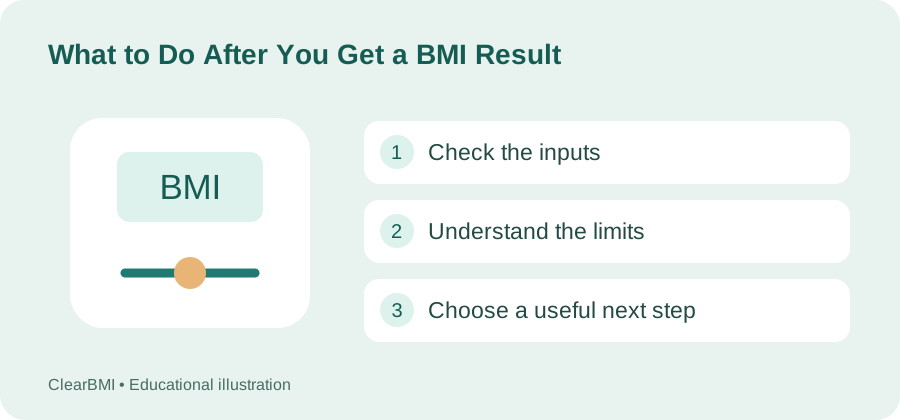
A calculator can display a number in a second, but deciding what it means takes more context. Before turning a BMI result into a goal or a worry, check the inputs and identify what question you are trying to answer. This guide explains a sensible next step without pretending that a website can assess your personal health.
First, verify the measurements
Check whether you entered centimeters or feet and inches, and kilograms or pounds. Use a recent measured height when possible, rather than an old remembered figure. Note the date and conditions of the weight measurement so later comparisons are meaningful. A typo or unit mismatch can create a striking result that disappears when corrected.
For example, an adult weighing 68 kg at 1.70 m has a BMI of 68 ÷ 2.89, or about 23.5. Entering 170 as meters rather than centimeters would produce a completely different number. Our calculator handles the conversion according to the selected units, but you still need to choose the right fields.
Check whether adult categories are appropriate
The categories displayed here are intended for adults aged 20 and older, following the CDC adult reference. Children and teens need BMI-for-age assessment, and pregnancy requires different interpretation. A standard adult category also does not settle questions about athletic muscle mass, illness-related weight change or an individual treatment plan.
If the calculator is not appropriate for your situation, avoid forcing the result into an adult label. A qualified healthcare professional can explain which assessment fits your age and circumstances.
Separate a screening category from a diagnosis
BMI expresses weight relative to height. It does not directly measure body fat or distinguish fat from muscle and bone. CDC advises considering it with other information such as medical history, behaviors, physical examination and laboratory findings. A result within a typical adult range does not prove the absence of health problems, and a result outside it does not tell you their cause.
Near a category boundary, small measurement differences can change the label. At 1.70 m, 72 kg gives about 24.9, while 73 kg gives about 25.3. The change in category should not be treated as proof that your health changed abruptly between those measurements.
Prepare a small set of useful questions
- Is this result useful given my age, medications and medical history?
- Has my weight changed unintentionally, and over what period?
- Which other measurements would help us understand my health?
- Would changes to eating, activity or sleep be appropriate for me?
- What should I monitor, and when should we review it?
Bring the measurements and any relevant symptoms rather than just a screenshot of the category. If you have experienced unintended weight changes, mention appetite, illness, medication changes or other circumstances. Do not start an extreme diet simply because a label feels alarming.
Choose an action you can assess
If there is no urgent concern and general habit changes are appropriate, choose one practical action: organize a repeatable lunch, make room for comfortable movement or improve your sleep routine. Record whether it fits your day and how you feel. These observations can support a later discussion without treating body weight as the only outcome that matters.
If tracking weight or food becomes distressing, you can use a less intrusive approach with professional support. A tool should help you understand a situation, not pressure you into restrictive behavior.
Keep the result in proportion
Save the inputs if you want to compare later, but avoid recalculating repeatedly from minor day-to-day changes. The useful outcome is a clearer question or a manageable next step. Personal care decisions belong in a conversation that includes your history, symptoms and preferences.
Keep reading: