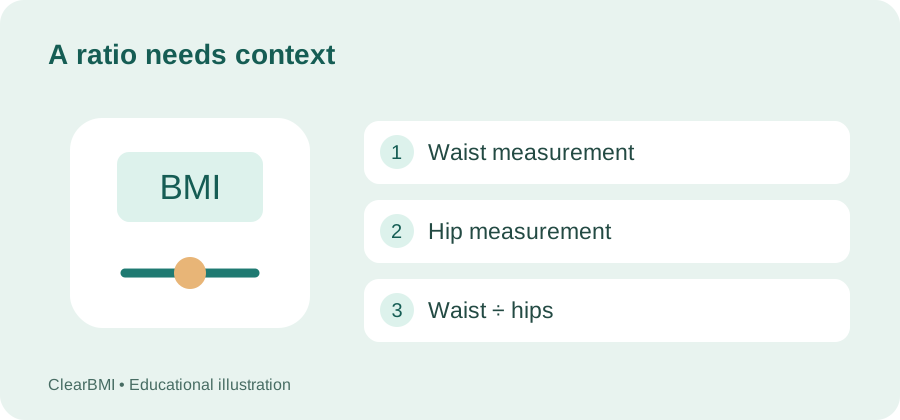
Two people can share the exact same BMI and still carry meaningfully different health risk — largely because of where their body stores fat, something BMI has no way to measure. That's where waist-to-hip ratio comes in.
What waist-to-hip ratio actually measures
Waist-to-hip ratio (WHR) is calculated by dividing waist circumference by hip circumference, both measured with a simple tape measure. Unlike BMI, which only considers total weight relative to height, WHR captures something about where weight is distributed — specifically, how much fat is concentrated around the abdomen versus the hips and thighs.
How to measure it correctly
- Waist: measure around the narrowest part of your torso, usually just above the belly button, at the end of a normal exhale.
- Hips: measure around the widest part of your hips and buttocks.
- Divide: waist measurement ÷ hip measurement = your WHR.
General reference ranges commonly cited in research suggest a WHR below 0.85 for women and below 0.90 for men is associated with lower average health risk, though these thresholds vary somewhat across different guidelines and populations.
Why abdominal fat gets special attention
Research has consistently linked visceral fat — fat stored around abdominal organs rather than just under the skin — with elevated risk for cardiovascular disease and type 2 diabetes, independent of total body weight. This is the core reason two people with identical BMI can face different health risk: one may be carrying more fat around the midsection, the other more around the hips and thighs, a pattern often described as "apple" versus "pear" body shapes.
BMI vs WHR: what each is actually good for
- BMI — fast, free, requires only height and weight, useful as a first-pass general screening tool.
- WHR — requires a tape measure and a bit more care, but adds real information about fat distribution that BMI simply can't provide.
Neither replaces the other. Many health professionals use both together: BMI for a general size classification (calculate yours with our free BMI calculator), and waist measurement or WHR for a more nuanced view of health risk, especially for people in the "overweight" category where distribution matters most.
A simpler alternative: waist circumference alone
Some guidelines favor waist circumference on its own over the full waist-to-hip ratio, since it's simpler to measure and still captures most of the useful signal about abdominal fat. Commonly cited general risk thresholds are a waist circumference above roughly 94 cm (37 in) for men and 80 cm (31.5 in) for women, associated with increased average health risk — though, as with all population-level thresholds, individual context matters.
Putting it together
If your BMI falls in the "overweight" or "obese" range, checking your waist circumference or waist-to-hip ratio adds useful context: a proportionate distribution changes the picture somewhat compared to concentrated abdominal fat. Neither measurement alone tells the whole story, which is exactly why combining a couple of simple, free measurements gives a fuller picture than any single number.
This article is educational and general. For a full risk assessment, consult a healthcare provider.
A worked ratio example
A waist measurement of 84 cm and a hip measurement of 100 cm gives a ratio of 0.84. Use the same units for both measurements. Keep the tape level and avoid pulling it tight enough to indent the skin. A different tape position can change the result, so write down the method and repeat consistently. Do not treat a single ratio as a diagnosis or borrow a cutoff without checking the population and measurement protocol it applies to. Clinical assessment can consider waist size alongside BMI and other findings.
Keep reading: