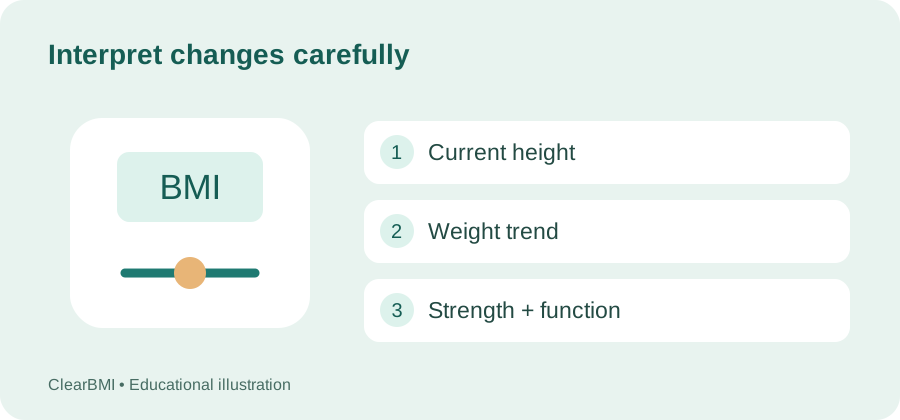
The BMI formula itself never changes — it's always weight divided by height squared, at any age. What changes is what a given number is likely to represent, because the body's composition shifts substantially across the adult lifespan even when the scale doesn't move much.
The core shift: muscle to fat, even at a stable weight
Starting around the 30s and accelerating with age, many adults gradually lose muscle mass — a process called sarcopenia — while gaining a roughly equivalent amount of fat mass, particularly if physical activity declines. This means someone can have the exact same weight, height, and therefore BMI at 30 and at 60, while carrying meaningfully more body fat and less muscle at the later age. BMI, calculated the same way described in our calculation guide, simply can't detect this shift.
Why this matters for interpreting your result
A "healthy weight" BMI at 65 doesn't necessarily reflect the same body composition, or the same health risk profile, as the identical BMI at 25. Some research has suggested that slightly higher BMI thresholds may be associated with better outcomes in older adults compared to younger populations — a nuance the standard fixed categories don't capture, since they apply the same 18.5–24.9 "healthy" range regardless of age.
Height changes with age too
It's a lesser-known fact that adult height itself gradually decreases with age — commonly by a centimeter or more per decade after around age 40, due to changes in spinal disc height and posture. Since height is part of the BMI formula, using an outdated height measurement from years earlier will skew the result, however slightly. It's worth re-measuring height periodically, particularly for older adults, rather than assuming it hasn't changed.
What tends to happen at different life stages
- 20s–30s: generally the highest natural muscle mass and metabolic rate for most people; BMI in this range often correlates fairly well with body fat levels.
- 40s–50s: gradual muscle loss typically begins if strength training isn't part of a regular routine, and fat can increase even at a stable weight.
- 60s and beyond: further muscle loss risk increases without intervention, and some research suggests being in the "overweight" BMI category may carry less added risk (and in some studies is associated with better outcomes) than being underweight, particularly for frailty-related concerns.
What this means practically
If your BMI has stayed roughly the same for years, that consistency alone doesn't guarantee your health status has too — periodic reassessment of muscle mass (through strength, mobility and function, not just the scale) becomes increasingly relevant with age. Strength training, covered in our beginner's guide, is one of the most well-supported ways to counteract age-related muscle loss.
The takeaway
BMI remains a useful quick check at any age, calculated the same way with our free BMI calculator — but the older you are, the more valuable it becomes to pair it with other indicators: strength, mobility, waist circumference, and a conversation with a healthcare provider familiar with your history.
This article is educational and general in nature, not personalized medical advice.
Measure current height, not remembered height
Consider an older adult weighing 68 kg. At 1.70 m their BMI is about 23.5, while at 1.67 m it is about 24.4. The weight is unchanged; the height used in the calculation changed. This is a reason to use a recent measured height, not to assume that the higher result proves fat gain. For older adults, appetite, unintended weight loss, strength and ability to manage everyday activities are useful discussion points. Weight loss after illness deserves individual assessment even when the BMI still falls within a typical adult category.
Keep reading: