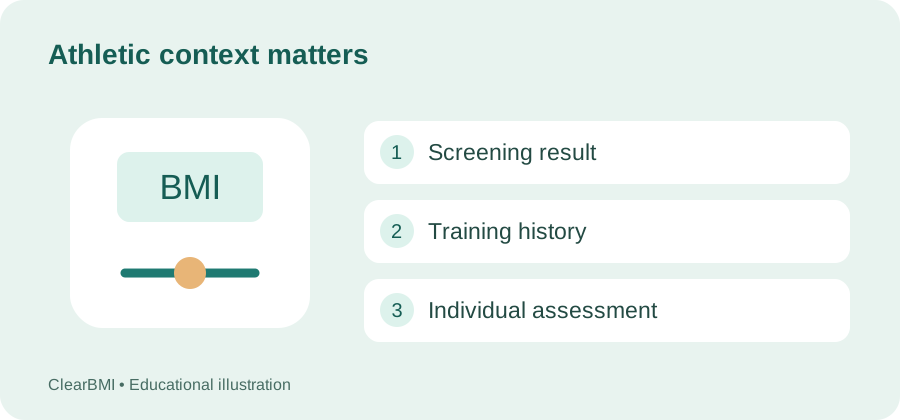
It's a familiar story: a fit, muscular person plugs their numbers into a BMI calculator and gets labeled "overweight" or even "obese," despite visibly low body fat and excellent fitness. This isn't a bug in the calculation — it's a structural limitation of what BMI actually measures.
Why this happens: density, not just weight
Muscle tissue is denser than fat tissue — roughly 18% denser by volume, according to widely cited body composition research. That means a given volume of muscle weighs meaningfully more than the same volume of fat. Since BMI is purely weight relative to height, it has no way to tell whether that extra weight is muscle or fat — it registers identically as "more weight for this height" either way.
Who this affects most
- Strength and power athletes — weightlifters, rugby players, American football players, and similar athletes commonly show BMI results in the overweight or obese range despite low body fat percentages.
- Bodybuilders — an extreme, well-known example; competitive bodybuilders often have BMIs well above 25 while carrying single-digit body fat percentages.
- Anyone with a dedicated strength training habit — even recreational lifters who've built meaningful muscle mass over years can see their BMI creep upward despite getting leaner, not heavier, in terms of fat.
How to tell if this applies to you
A few practical signals suggest your BMI result might be misleading due to muscle mass rather than fat:
- You strength train regularly and have visibly gained muscle over time
- Your waist circumference is proportionate and doesn't show significant abdominal fat accumulation (see our waist-to-hip ratio guide)
- Clothes fit similarly or better despite the scale trending up
- You feel strong, energetic, and your fitness metrics (strength, endurance) are improving, not declining
Better tools for athletes and muscular individuals
Body fat percentage
This directly measures the proportion of your weight that's fat versus lean mass, sidestepping BMI's core blind spot entirely. Methods range from simple skinfold calipers to more precise options like DEXA scans. See our body fat vs BMI comparison.
Waist circumference
A simple tape-measure reading around the waist gives useful information about fat distribution that BMI can't provide, and isn't affected by muscle mass the way BMI is.
Performance and functional markers
Strength benchmarks, cardiovascular fitness (like a resting heart rate or a timed run), and how your body actually functions day to day often tell a more complete story for athletes than any single size-based number.
Should athletes ignore BMI entirely?
Not necessarily — it's still a free, instant data point, and tracking your own BMI over time (rather than comparing to the general population thresholds) can still flag meaningful changes worth investigating. The key adjustment is context: if you know you're carrying significant muscle mass, treat a high BMI result as expected rather than alarming, and lean on body fat percentage or waist measurements for a more accurate read.
Calculate your number with our free BMI calculator, and interpret it with this context in mind rather than the general population categories alone.
This article is educational and general — not personalized fitness or medical advice.
Bring training context to the appointment
An athlete with a high BMI should explain their sport, training volume and recent changes in weight or performance. That context helps a clinician decide whether additional assessment is useful. It does not prove that all extra weight is muscle, and a visibly muscular build does not rule out high blood pressure or other conditions. Consumer body-fat scales also have measurement limitations. Use a consistent method when tracking, and do not compare a home scale reading directly with a laboratory measurement as if the methods were interchangeable.
Keep reading: