Precisely weighing every meal works well for some people, but it's not necessary for most everyday eating, and it's not sustainable for many. A handful of visual comparisons can get you most of the way to a reasonable portion sense without any equipment.
Hand-based portion guides
Using your own hand as a reference is convenient because it scales roughly with your own body size — someone with larger hands generally has correspondingly higher energy needs, and vice versa.
- Palm (thickness and area, not fingers) — roughly one portion of protein: meat, fish, poultry, or tofu.
- Cupped hand — roughly one portion of carbohydrates: rice, pasta, potatoes, or cereal.
- Fist — roughly one portion of vegetables or fruit.
- Thumb (whole thumb, not just the tip) — roughly one portion of fats: oils, nut butter, or cheese.
These are general approximations, not precise measurements, but they're consistent enough for everyday use without needing a scale or measuring cups every meal.
Common object comparisons
For foods that don't fit neatly into the hand-based system:
- A serving of cheese is roughly the size of a pair of dice or a thumb
- A serving of nuts is roughly a small handful, cupped in one palm
- A serving of oil for cooking is roughly a thumb-tip amount, or about one tablespoon
- A baked potato portion is roughly the size of a computer mouse
Why plate composition matters more than exact portions for most people
For everyday eating (as opposed to specific athletic or medical goals requiring precision), the overall composition of a meal — a reasonable mix of protein, carbohydrate, vegetables, and some fat — tends to matter more than getting each portion exactly right. Our balanced plate guide covers a simple visual method for this that pairs well with the hand-based portions above.
Restaurant and packaged portions are often larger than a "standard" serving
This is one of the most common sources of unintentional overeating: a restaurant entrée or a "single-serving" packaged snack frequently contains two or more standard servings by nutritional label standards (see our nutrition label guide on this exact issue). Being aware of this — without needing to weigh anything — helps recalibrate expectations when eating out or opening a package.
When precise measurement is genuinely useful
Weighing food is a reasonable and often helpful approach for specific situations: competitive athletes with precise nutrition targets, certain medical conditions requiring careful nutrient tracking, or anyone who finds tracking numbers personally motivating and sustainable rather than stressful. It's a tool, not a requirement — plenty of people maintain a healthy relationship with food and a stable weight using visual estimation alone.
A practical starting point
Try using the hand-based guide for a week without weighing anything, and see how it compares to your usual portions. For most people, it's accurate enough to build meals around, without the friction of measuring cups and a kitchen scale at every meal.
This article is educational and general in nature. If you have a specific medical condition requiring precise nutrient tracking, follow guidance from your healthcare provider.
Serving size is not a command
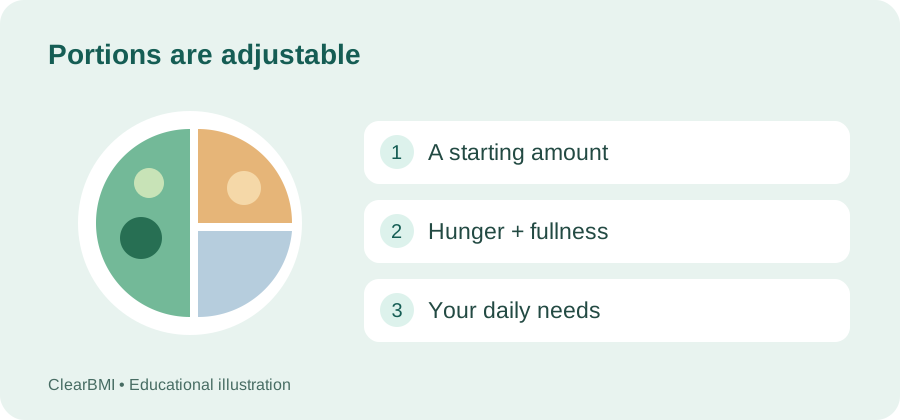
If a package defines a serving as 30 g, eating 45 g means multiplying the listed nutrients by 1.5. It does not mean you failed to follow a prescribed portion. Label servings help describe amounts; your appropriate portion depends on the rest of the meal and your circumstances. At home, use a familiar bowl or plate as a consistent starting point and adjust after checking appetite. Hand-based estimates can be convenient but are rough approximations, especially for mixed dishes, oils and foods with very different densities.
Keep reading: