
Nutrition labels are designed to be informative, but the sheer number of figures crammed onto a small panel can make them feel more confusing than helpful. Here's how to read one efficiently, focusing on what actually matters for most people.
Start with the serving size — always
This is, by a wide margin, the most commonly misread part of any label. Every number on the label — calories, fat, sugar, everything — is based on a single serving, and the serving size is often smaller than what people actually eat in one sitting. A bag of chips might list a serving as 15 chips when a "normal" portion for many people is closer to 30 or 40. Always check the serving size first, and mentally multiply the rest of the label accordingly if you eat more than one serving.
Check servings per container next
Directly below or beside the serving size, this tells you how many servings the whole package contains. If a package has 3 servings and you eat the whole thing, you've consumed three times every number listed on the label — a common source of accidentally underestimating calorie or sugar intake.
The nutrients most worth glancing at
- Added sugars — listed separately from "total sugars" on most modern labels. This distinction matters because total sugars include naturally occurring sugar (like in fruit or plain milk), while added sugars reflect what's been mixed in during processing. See our added sugar guide for more.
- Fiber — listed under total carbohydrates; higher fiber content is generally associated with more nutritional value per calorie. More in our fiber guide.
- Sodium — easy to underestimate in packaged and restaurant food; relevant particularly for anyone monitoring blood pressure.
- Type of fat — saturated and trans fat are broken out separately from total fat; see our guide on healthy vs. unhealthy fats.
Percent Daily Value (%DV): a quick reference, not a hard rule
The %DV column shows how much a nutrient in one serving contributes to a general daily reference amount (based on a standard reference diet, which may not match your individual needs). A commonly used rough guide: 5% DV or less is considered low for that nutrient, and 20% DV or more is considered high. This is most useful for quickly comparing similar products against each other rather than as a precise personal target.
The ingredients list tells a different story than the nutrition panel
The nutrition facts panel shows quantities; the ingredients list, printed separately, shows what's actually in the product, listed by weight from most to least. A product can look reasonable on the nutrition panel while having a long list of additives or multiple forms of added sugar (corn syrup, cane sugar, dextrose) spread throughout the ingredients — worth a quick scan alongside the numeric label.
A simple, fast approach for everyday shopping
- Check the serving size and servings per container first, and adjust your mental math accordingly.
- Glance at added sugar and fiber, since these two numbers tell you a lot about a packaged food's overall nutritional quality quickly.
- Scan the ingredients list for anything unexpected, particularly near the top where the largest-quantity ingredients appear.
This quick three-step scan takes under 15 seconds once it's habitual, and covers most of what actually matters for everyday food choices without needing to analyze every number on the panel.
This article is educational and general in nature, not personalized dietary advice.
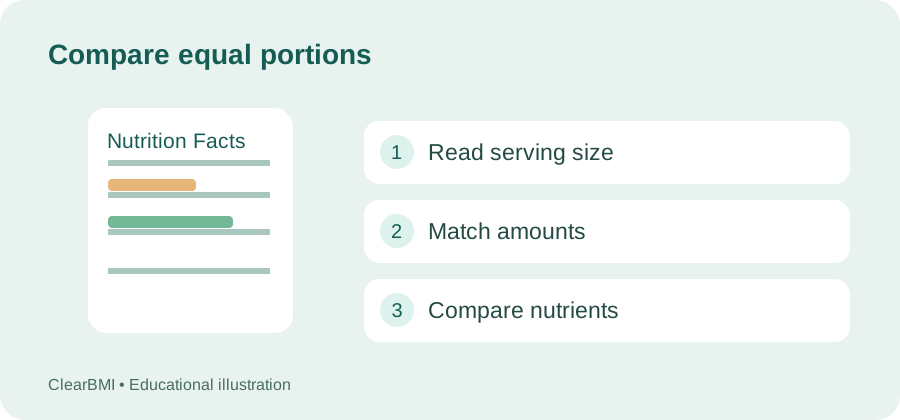
The serving-size trap
Imagine two fictional cereals. Cereal A lists 6 g of fiber per 60 g serving, while cereal B lists 4 g per 30 g serving. At the same 60 g amount, cereal B supplies 8 g of fiber. Comparing the printed numbers alone would miss this. The same arithmetic applies to sodium, added sugar and energy. First choose a realistic comparison amount, then scale both labels to it. After that, consider taste, cost, allergens and the foods you will eat alongside the cereal. One nutrient is not a complete product review.
Keep reading: