
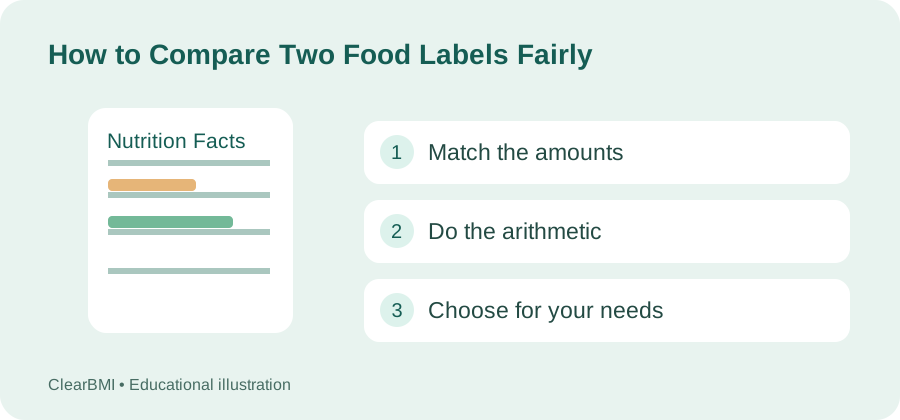
Two packages can make similar claims while using different serving sizes. One may highlight a low number per small serving; another may report more because its serving is twice as large. A fair comparison begins by making the amounts comparable. The calculations below use fictional products so you can practice the method without treating the example as a brand recommendation.
Step one: choose a common amount
Imagine cereal A uses a 40 g serving and cereal B uses a 60 g serving. You want to compare both at 60 g because that is the amount you are evaluating. Multiply each number on cereal A’s label by 60 ÷ 40, or 1.5. Cereal B’s figures need no adjustment. If your local labels already show values per 100 g, those columns offer another common basis.
The common amount is a comparison tool, not a recommended portion. You can use a different amount if that better reflects how you will use the food. Keep the same amount for both products.
A worked fictional example
| Nutrient | A: per 40 g | A: per 60 g | B: per 60 g |
|---|---|---|---|
| Energy | 150 kcal | 225 kcal | 220 kcal |
| Fiber | 3 g | 4.5 g | 6 g |
| Added sugars | 4 g | 6 g | 5 g |
| Sodium | 120 mg | 180 mg | 160 mg |
Comparing only the printed fiber numbers would suggest a larger difference than the equal-amount comparison shows. Cereal B still has more fiber in this example, but the relevant comparison is 6 g versus 4.5 g. For cereal A’s sodium, the calculation is 120 × 1.5 = 180 mg. Apply the same multiplier to every value you are comparing.
Step two: decide which information matters
Choose a few relevant nutrients rather than searching for a product that wins every column. You might compare fiber in a cereal, sodium in a soup or added sugars in a flavored yogurt. On U.S. labels, the FDA describes 5% Daily Value or less as low and 20% or more as high per serving. These are quick label-reading reference points, not personalized daily targets.
Total sugar and added sugar are different measures. A dairy food or fruit-based product may contain naturally occurring sugars as well as added sweeteners. Check what your local label reports before comparing categories that are not equivalent.
Step three: read the ingredient and allergen information
Nutrient arithmetic does not replace checking ingredients. A product with favorable numbers may be unsuitable because of an allergy, intolerance or dietary requirement. Read the actual package each time, since formulations can change. Front-of-package terms such as “natural” or “fitness” do not tell you whether an ingredient is safe for you.
Also consider how you eat the food. Cereal with milk, yogurt or toppings is a different meal from dry cereal alone. A sauce may be used in small amounts across several servings. Keep the comparison grounded in real use rather than isolated package claims.
Finish with a practical choice
If two products meet your needs, price, taste, availability and waste can decide the choice. A slightly different nutrient profile may be less important than whether you enjoy the food and use it. Keep the calculation simple: same amount, relevant nutrients, suitable ingredients and realistic use. If a medical condition requires a particular target, use the plan from your care team.
Keep reading: