
Nutrition information travels fast and often loses nuance along the way. A handful of claims keep resurfacing despite not holding up particularly well against the broader body of research.
Myth: "Carbs make you gain weight"
Weight gain results from a sustained excess of calories relative to what the body uses, regardless of whether those calories come from carbohydrate, fat, or protein. Carbohydrates aren't uniquely fattening — the confusion often comes from the fact that refined carbohydrate sources (sugary drinks, refined snacks) are easy to overconsume and often low in fiber, not from carbohydrates as a category. See our macronutrients guide for more context.
Myth: "Eating late at night causes weight gain"
Research on meal timing specifically (independent of total daily intake) shows a much weaker and less consistent effect than commonly claimed. What matters more is total intake across the day and the quality of food choices — late-night eating tends to correlate with less mindful, often lower-quality food choices, which is likely the actual driver in most real-world cases rather than the clock time itself.
Myth: "Detox diets and cleanses remove toxins"
The human liver and kidneys are already highly effective at filtering and eliminating waste products continuously; there's no strong evidence that commercial detox products or juice cleanses meaningfully improve this built-in process. Many "detox" effects people notice (feeling lighter, temporary weight change) are more plausibly explained by reduced calorie and sodium intake during the cleanse period, not toxin removal.
Myth: "Skipping meals is an effective way to lose weight"
While intermittent fasting approaches have legitimate research behind them for some people, simply skipping meals inconsistently often leads to increased hunger and overeating later in the day, and doesn't reliably produce better outcomes than a consistent eating pattern for most people. Individual responses vary considerably here.
Myth: "Natural or organic automatically means healthier"
"Natural" and "organic" are largely regulatory and farming-practice labels, not nutritional ones. Organic sugar is still sugar; a "natural" snack food can still be high in refined carbohydrates and low in fiber. These labels are worth understanding for what they actually certify (farming methods, additive restrictions) rather than treating them as a general health guarantee.
Myth: "You need to eat every 2-3 hours to keep your metabolism running"
Meal frequency has a much smaller effect on metabolic rate than commonly believed — total daily intake and overall dietary pattern matter far more than how many times per day it's divided into. Some people do better eating smaller, frequent meals for appetite management reasons, and others do fine with fewer, larger meals; neither pattern has a clear metabolic advantage over the other for most people.
Myth: "Fat-free or low-fat products are always the better choice"
Manufacturers frequently compensate for removed fat with added sugar or refined starch to maintain taste and texture, which can leave a "low-fat" product nutritionally similar to, or sometimes worse than, its full-fat counterpart. Checking the full label, as covered in our nutrition label guide, is more reliable than trusting a front-of-package claim alone.
Why these myths persist
Simple, absolute claims spread more easily than nuanced ones, and nutrition science genuinely is complex, with legitimate ongoing debate in some areas. A reasonable general approach: be skeptical of claims that sound too simple or too dramatic, and favor guidance grounded in broader consensus over single studies or purely anecdotal claims.
This article is educational and general in nature, not personalized dietary advice.
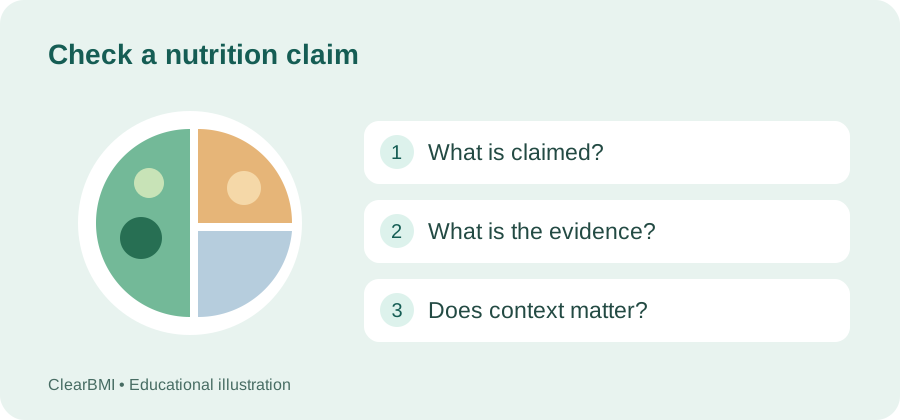
A quick test for a “detox” claim
Ask the seller what the product is supposed to remove, how that substance was measured and whether a controlled study tested the finished product. A before-and-after photo or a customer testimonial cannot answer those questions. Also check whether the advice depends on an expensive supplement, an extreme restriction or a promised result for everyone. A claim may use a real biological term while drawing an unsupported practical conclusion. Keep ordinary meals, affordability and any medication interactions in view before adopting a new regimen.
Keep reading: