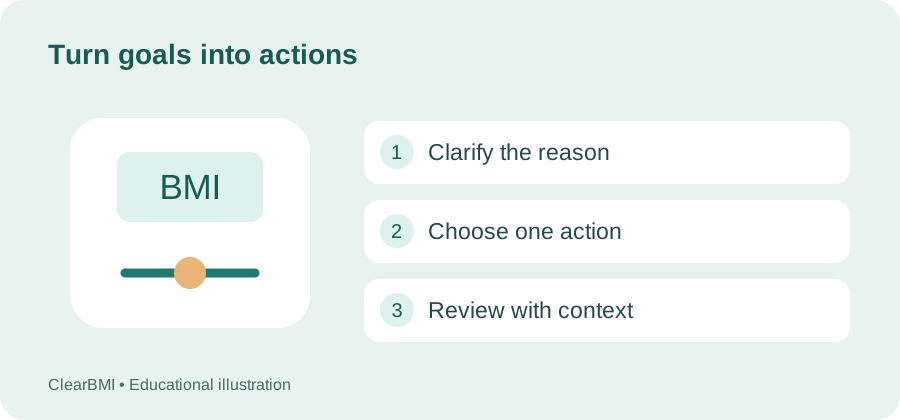
A huge number of weight-related goals are abandoned within weeks — not necessarily because the person lacked discipline, but because the goal itself was set in a way that made long-term success unlikely from the start. Here's a more grounded approach.
Step 1: Start from information, not a random number
Rather than picking a target weight because it's a round number or matches someone else's frame, start with your current BMI (using our free calculator) and your healthy weight range from our healthy weight ranges guide. If you're already within that range, a "goal" might reasonably be about body composition or fitness rather than the scale at all.
Step 2: Separate the outcome goal from the process
"Lose weight" is an outcome, not something you can directly act on day to day. A more useful approach splits the goal into two layers:
- Outcome goal — where you'd eventually like to land (e.g., a general range, not necessarily a single exact number)
- Process goals — the specific, repeatable actions that plausibly get you there, like a consistent bedtime, a daily walk, or cooking most meals at home
Process goals are what you actually control day to day, which is why they matter more for consistency than fixating on the outcome number.
Step 3: Aim for gradual, not aggressive, change
Widely cited general guidance from health organizations suggests that gradual weight change — typically framed as a modest percentage of body weight per month — tends to be more sustainable and more likely to stay off long-term than rapid loss. Aggressive, fast timelines are strongly associated with regaining weight afterward, largely because the underlying habits weren't sustainable in the first place. If you're working toward a specific number, a doctor or registered dietitian can help set a pace appropriate for your individual situation.
Step 4: Build in flexibility from the start
Rigid, all-or-nothing goals ("I will never eat X again") tend to break down at the first slip and often lead to abandoning the whole effort. A goal with built-in flexibility — most days following a pattern, without treating occasional exceptions as failure — tends to hold up much better over months and years. Our guide on building a sustainable habit covers this in more depth.
Step 5: Track something other than just the scale
Body weight naturally fluctuates day to day due to water retention, digestion, and hormonal factors, which can make the scale a frustrating and misleading short-term signal. Our guide on tracking progress without relying only on the scale covers alternative signals — energy levels, how clothes fit, strength gains — that often better reflect real progress.
Step 6: Revisit and adjust, rather than restart from scratch
A realistic goal isn't fixed in stone. If your circumstances change — a new job, an injury, a stressful period — adjusting the goal is a sign of good judgment, not failure. Treating any deviation as needing a complete restart ("I'll begin again Monday") is one of the most common ways well-intentioned goals get derailed entirely.
Bringing it together
Use your BMI and healthy weight range as a starting orientation, not a rigid target — set specific, repeatable process goals rather than only an outcome number, and build in enough flexibility that a single off day doesn't unravel the whole plan.
This article is educational and general. For a plan tailored to your specific health history, consult a doctor or registered dietitian.
Separate the outcome from the weekly task
A goal such as “feel less out of breath on my usual route” can be paired with a specific task: take a comfortable walk after lunch on three days this week. Record whether the task happened and how manageable it felt. This gives you information even when weight does not change. If weight loss is clinically appropriate, agree on a realistic approach with your healthcare provider rather than copying another person’s target. Reassess the plan if it causes persistent fatigue, food anxiety or difficulty keeping up with everyday responsibilities.
Keep reading: