You don't need to do this by hand — our free BMI calculator does it instantly — but walking through the math once makes the whole concept click, and it's genuinely simple.
The metric formula
BMI = weight in kilograms ÷ (height in meters × height in meters)
Worked example
Say someone weighs 70 kg and is 1.75 m tall.
- Square the height: 1.75 × 1.75 = 3.0625
- Divide weight by that number: 70 ÷ 3.0625 = 22.86
- Round to one decimal place: BMI = 22.9
That falls in the "healthy weight" range (18.5–24.9) described in our BMI categories guide.
The imperial formula
BMI = (weight in pounds ÷ (height in inches × height in inches)) × 703
The 703 multiplier exists purely to convert the units so the result lines up with the same scale as the metric version — without it, pounds and inches alone would produce a completely different, non-comparable number.
Worked example
Say someone weighs 154 lb and is 5'9" (69 inches) tall.
- Square the height: 69 × 69 = 4,761
- Divide weight by that: 154 ÷ 4,761 = 0.03234
- Multiply by 703: 0.03234 × 703 = 22.7
- BMI ≈ 22.7
Notice this lands close to the metric example above — that's expected, since 154 lb and 5'9" are roughly the same body as 70 kg and 1.75 m.
Common mistakes when calculating by hand
- Forgetting to convert height to meters (not centimeters) in the metric formula. Using 175 instead of 1.75 will produce a wildly wrong result.
- Forgetting the 703 multiplier in the imperial formula. Without it, the number will be far too small to mean anything.
- Mixing unit systems — e.g., using kilograms with inches. Both values need to be in the same system before you start.
Why bother doing it manually at all?
Two good reasons: first, understanding the math demystifies the number — it's not some opaque medical formula, just weight divided by height squared, plus a unit conversion constant if you're using imperial units. Second, it's genuinely useful for sanity-checking any calculator (including ours) or for quick mental estimates when you don't have your phone handy.
When you'd rather skip the math
For everyday use, our free BMI calculator handles both unit systems instantly, shows your category, and places your result visually on the standard scale — all without needing to remember a formula or a conversion constant.
This article is for general educational purposes and isn't a substitute for personalized medical advice.
Check the units before the arithmetic
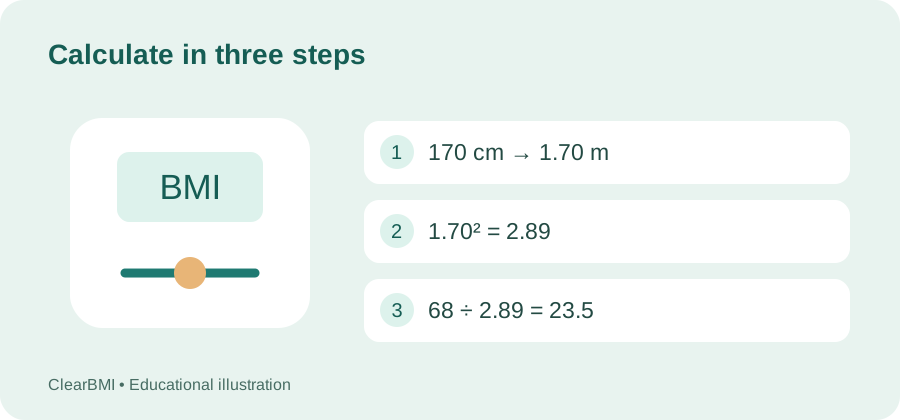
For 170 cm and 68 kg, convert centimeters to meters first: 170 ÷ 100 = 1.70. Square the height: 1.70 × 1.70 = 2.89. Divide the weight by that value: 68 ÷ 2.89 = 23.53. Round the final display to 23.5, rather than rounding the intermediate steps. A result near zero often means centimeters were used as meters. A very large result may mean the decimal point was misplaced. Keep the original measurements to make the calculation reproducible.
Keep reading: