Metabolism refers to the processes that sustain body functions and use energy. It is broader than a simple “fast” or “slow” label. A change in weight, or a few weeks without a change, cannot measure your metabolism or establish that it is damaged.
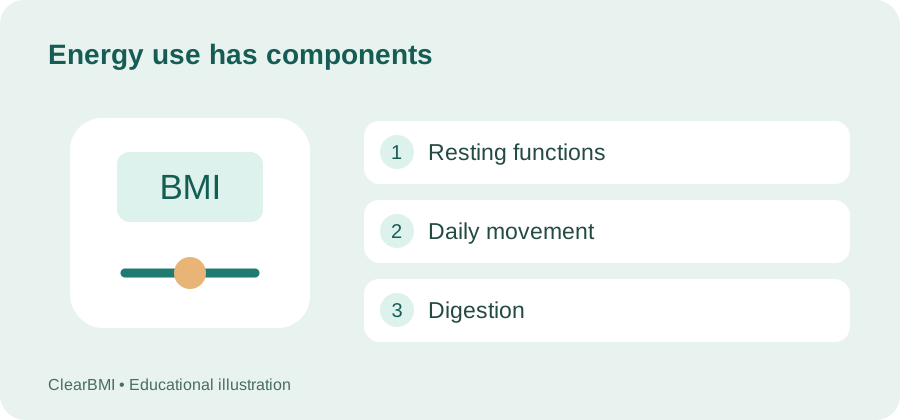
Energy use has several components
- Resting functions: breathing, circulation and other ongoing processes require energy.
- Daily movement: errands, household tasks and movement at work contribute.
- Exercise: planned activity adds to the daily total.
- Digestion: processing food also uses energy.
The size of these components differs between people and circumstances. A simple online equation estimates a population average; it does not directly measure an individual’s energy use. BMI is a different calculation altogether and does not measure metabolism.
Do not compare two people from appearances alone
Two people who look similar may have different routines, medical histories, medications and body composition. Observing what somebody eats at one meal also does not reveal their full intake over time. These gaps make casual comparisons a poor basis for a diagnosis or an exact calorie prescription.
Be specific about a supplement claim
“Boosts metabolism” can refer to a laboratory measurement, a short-term effect or a vague marketing promise. Those are not equivalent to showing a useful long-term outcome in the people who will buy the product. Ask what was tested, how large the effect was and whether the finished product was studied. Ingredients can also have side effects or interactions.
There is no reason to start a supplement simply because weight has stayed stable. Our nutrition claims guide offers a short checklist for evaluating such promises.
Consider routine, medication and health context
NIDDK notes that weight can be influenced by habits, sleep, medicines, medical conditions and inherited factors. This makes a single-cause explanation unreliable. If your activity, appetite or schedule changed, record the change. If medication changed, discuss concerns with the prescriber rather than adjusting treatment yourself.
Persistent symptoms or unintended weight changes should be assessed. A blog cannot distinguish a routine change from an endocrine condition, and a normal BMI does not rule one out.
Choose an action that answers a useful question
Instead of trying to “repair” a number you have not measured, choose a manageable observation or habit. You might record whether a work schedule has reduced movement, organize more regular meals or discuss fatigue with your clinician. Strength training may be part of an appropriate activity routine, but it should not be sold as a dramatic metabolic fix.
A short record of what actually changed can support a care conversation. Avoid extreme restriction to force a response from your body or interpreting daily weight variation as proof that a product worked. The useful goal is understanding and an appropriate next step.
Avoid diagnosing yourself from a plateau
If weight stays stable for a few weeks, it does not by itself prove that your metabolism is damaged. Measurement variation, changes in routine, medication, appetite and activity can all affect the picture. Write down what actually changed before looking for a single explanation. Persistent cold intolerance, marked fatigue or other symptoms deserve medical assessment rather than a supplement marketed as a metabolic fix. A calculator estimates from population averages; it cannot measure your personal resting energy use or rule out an underlying condition.
Keep reading: