
Strength training gets recommended constantly, and for good reason — but the gap between "you should do this" and "here's exactly how to start" is where a lot of good intentions stall out. This is meant as that missing entry point.
Why strength training matters beyond aesthetics
Building and maintaining muscle mass supports bone density, joint stability, and functional strength for everyday tasks, and helps counteract the age-related muscle loss described in our guide on how BMI changes with age. It's also associated in research with metabolic health benefits, including support for healthy blood sugar regulation, independent of any weight or aesthetic changes.
You don't need a gym to start
Bodyweight exercises — using nothing but your own body as resistance — are a completely legitimate starting point and remain useful even for more experienced people. A gym membership and equipment become more relevant once bodyweight movements feel too easy, not before.
The core movement patterns worth learning
Rather than memorizing individual exercises, it's more useful to understand the basic movement patterns that most effective strength routines are built around:
- Squat pattern — bending at the hips and knees (bodyweight squats, chair squats)
- Hinge pattern — bending primarily at the hips with a straighter back (glute bridges, later progressing to deadlift variations)
- Push pattern — pushing weight away from the body (push-ups, wall push-ups as an easier variation)
- Pull pattern — pulling weight toward the body (rows using a resistance band or household item, later progressing to pull-ups)
- Core/stability — planks, dead bugs, and similar movements that build trunk stability supporting all the other patterns
A simple beginner routine covering each pattern, even with basic bodyweight versions, provides a solid, balanced foundation.
A realistic beginner structure
- Frequency: 2-3 sessions per week, with at least one rest day between sessions targeting the same muscle groups
- Volume: 2-3 sets of each movement, in a rep range that feels challenging by the last couple of repetitions without breaking form
- Progression: gradually increasing repetitions, sets, or difficulty (adding resistance bands, then weights) as movements start to feel manageable
Common beginner concerns, addressed
"Will I get bulky?"
Significant muscle growth requires a sustained, deliberate combination of progressive training, sufficient protein intake, and often a calorie surplus, over a long period of time — it doesn't happen accidentally from a couple of beginner sessions a week.
"Is it safe to start without a trainer?"
Learning proper form for basic bodyweight movements from reputable instructional resources, starting conservatively, and progressing gradually is a reasonable approach for most healthy adults. Anyone with an existing injury, joint condition, or other health concern should check with a doctor or physical therapist before starting.
"What if I'm sore afterward?"
Mild muscle soreness in the day or two following a new type of exercise is a normal adaptation response, not necessarily a sign of injury or overtraining. Sharp or joint pain, as opposed to general muscle soreness, is a different signal worth paying attention to and adjusting for.
Where this fits into overall exercise recommendations
Strength training complements rather than replaces the aerobic activity described in our weekly exercise guidelines — most general health guidelines recommend both, since each supports different aspects of physical health.
Getting started this week
Pick one exercise from each movement pattern above, at a beginner difficulty level, and try a short session — even 15-20 minutes covers a lot of ground when you're just starting out. Consistency over the following weeks matters far more than the specifics of the first session.
This article is educational and general. Consult a doctor before starting a new exercise program, particularly if you have an existing health condition or injury.
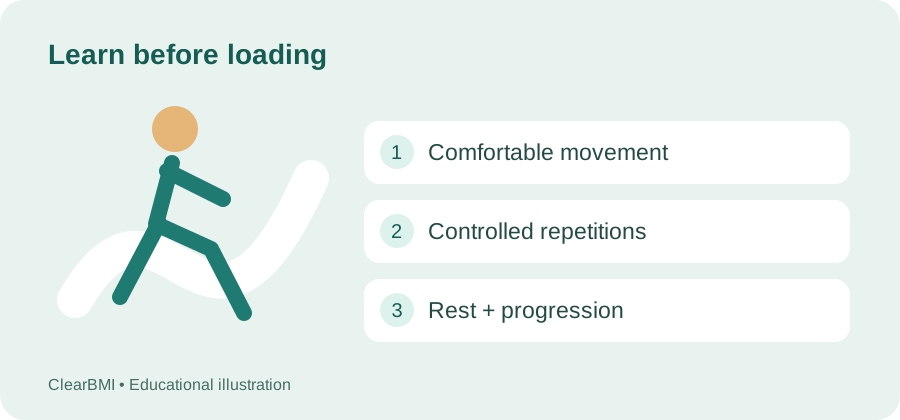
Choose a version you can control
For a first session, a sit-to-stand from a stable chair may be more useful than copying a heavily loaded gym exercise. Choose movements and resistance you can control, leave time to recover, and note what felt comfortable. If technique is uncertain, a qualified instructor can help adapt the movement. Pain is not a progress measure, and soreness is not required for a useful session. Increase difficulty only when the current version feels manageable; recovery, injury history and medical conditions may change the appropriate starting point.
Keep reading: