
Body weight is easy to measure, which is exactly why it's become the default progress metric for so many people — but it's also one of the noisiest, most easily misread numbers available, for reasons that have little to do with whether your habits are actually working.
Why the scale alone is a limited signal
Body weight fluctuates day to day due to water retention, sodium intake, hormonal cycles, digestion, and even how recently you exercised — often by a kilogram or more within a single day, entirely unrelated to any actual change in fat or muscle. A single reading, or even day-to-day comparisons, can be genuinely misleading as a result.
Body measurements
Waist, hip, chest, and limb measurements, taken with a simple tape measure roughly every 2-4 weeks, can reveal changes in body composition that the scale misses entirely — particularly relevant if you're strength training, since muscle gain and fat loss can happen simultaneously in ways that leave total weight relatively unchanged while measurements shift meaningfully.
Progress photos
Taken consistently (same lighting, pose, and time of day, roughly monthly) progress photos often reveal changes that are hard to notice day-to-day in the mirror or that the scale doesn't capture, particularly changes in body composition and posture.
How clothes fit
A genuinely practical, low-effort signal — noticing that a particular pair of pants or a shirt fits differently over weeks is a real, tangible indicator that doesn't require any tracking tool at all.
Performance metrics
For anyone doing regular exercise, tracking performance — how much weight you can lift, how far or fast you can run, how many push-ups you can complete — often shows clear, motivating progress well before (or even without) any visible change in body composition. This is a particularly useful signal for people focused on strength training, covered in our beginner's guide.
Energy levels and sleep quality
Subjective but genuinely meaningful — many people notice improved energy, mood, and sleep quality (see our sleep and weight guide) well before any measurable change in weight or body composition, and these improvements are valuable in their own right, independent of any weight-related outcome.
Habit consistency itself
As covered in our guide on building a sustainable habit, tracking whether you actually did the behavior (took the walk, hit the protein target, got to bed on time) is a more immediate and controllable signal than any downstream outcome measure, which responds more slowly and noisily to your actual efforts.
If you do use the scale, use it wisely
Weighing at the same time of day, under similar conditions (typically first thing in the morning), and looking at the weekly or monthly trend rather than any single day's reading substantially reduces the noise problem described above. A weight trend line over several weeks is considerably more informative than any individual daily number.
Choosing what to track
There's no requirement to track everything listed here — pick one or two methods that feel meaningful and sustainable for your specific goals, whether that's a strength goal, a general health goal, or simply feeling better day to day, and revisit them on a realistic schedule (weekly or monthly, not daily) rather than obsessively.
This article is educational and general in nature, not personalized medical or fitness advice.
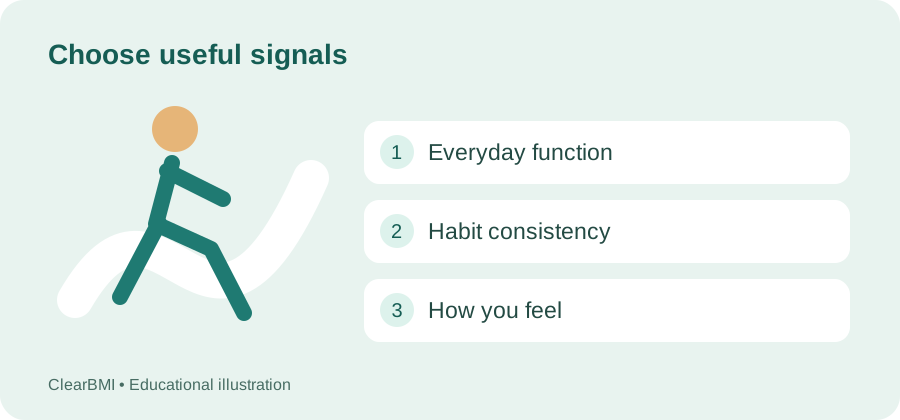
Use a small, repeatable record
Pick two measures that matter to you, such as completing a usual route comfortably and preparing lunch on workdays. Record them once a week using the same description. More comfortable walking is meaningful even if your weight is unchanged. Avoid collecting so many numbers that the record becomes a burden. Measurements, photos and wearable scores can also become distressing for some people; you can choose not to use them. If tracking increases anxiety or encourages restrictive behavior, discuss a less intrusive approach with a qualified professional.
Keep reading: