
Nearly every health habit starts with a burst of motivation that eventually fades — this isn't a personal failing, it's simply how motivation works as a psychological state: it fluctuates, and building a plan that depends on it staying high indefinitely sets up an eventual gap.
Understand that motivation was never meant to carry the whole load
Motivation is most useful for starting a new behavior; systems, environment design, and habit (covered in our habit-building guide) are what carry it through the inevitable periods when motivation naturally dips. Expecting sustained high motivation indefinitely is setting up for disappointment rather than planning realistically.
Lower the bar on low-motivation days, rather than skipping entirely
A useful principle from behavior change research: doing a smaller, easier version of a habit on a hard day (a 5-minute walk instead of the usual 30, a couple of exercises instead of the full routine) keeps the habit and its associated identity intact, which matters more for long-term consistency than the specific amount completed on any single day. All-or-nothing thinking — "if I can't do the full thing, there's no point" — is one of the most common ways consistent habits break down entirely.
Reduce the decision-making required in the moment
Willpower and motivation are both least available exactly when you need to make a decision under fatigue or stress. Pre-deciding — what you'll eat this week, when you'll exercise, what the fallback plan is on a busy day — removes the need to motivate yourself into a decision at the worst possible moment. This connects to the environment design principles in our sustainable habit guide.
Track streaks, but don't let a broken one derail everything
Visual habit trackers can provide genuine motivation through visible progress, but research on behavior change also flags a real risk: treating a broken streak as a reason to abandon the habit entirely (rather than simply resuming the next day) is a common and largely avoidable derailment. The goal is a general upward trend over months, not an unbroken chain that one bad day destroys.
Reconnect with your underlying reason, not just the immediate task
"I should exercise" is a weaker motivator than a specific, personally meaningful reason — more energy for your kids, reducing a specific health risk, feeling stronger for an activity you care about. Revisiting the actual underlying reason periodically, rather than just the surface-level task, tends to be more effective for reconnecting with motivation during a low period than generic willpower.
Accept that some periods genuinely aren't the right time for major change
Significant life stress — a family crisis, a demanding work period, illness — can make even well-designed habits genuinely harder to maintain, and that's a realistic circumstance rather than a personal failure. A reasonable response during genuinely difficult periods is scaling back to a minimal maintenance version of your habits, rather than either pushing through at full intensity or abandoning everything entirely.
Find some form of accountability
Research on behavior change consistently shows that external accountability — a friend, a family member, a coach, or even a simple public commitment — improves consistency for many people, since it adds a layer of motivation beyond internal willpower alone, which is exactly the resource that fluctuates most.
The realistic long-term picture
Nobody maintains perfect motivation or perfect consistency for years at a stretch. What separates people who maintain habits long-term isn't the absence of low-motivation periods — it's having a realistic, flexible system (smaller fallback versions, pre-made decisions, a way to resume after a break) that survives those periods rather than collapsing during them.
This article is educational and general in nature, not personalized medical or psychological advice.
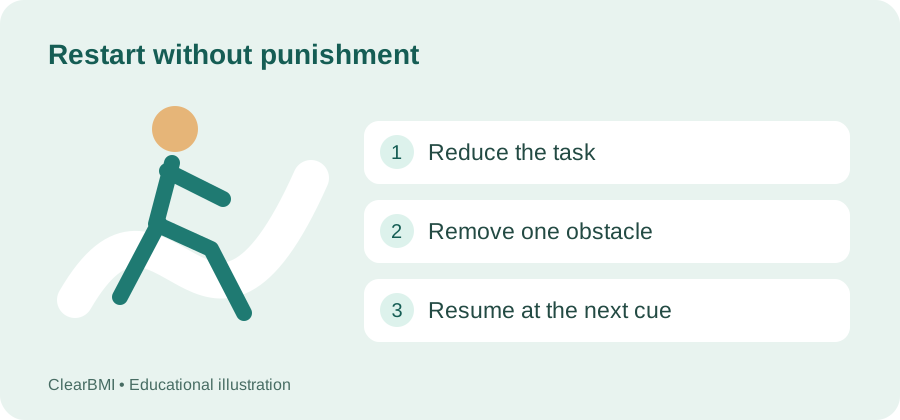
Plan your restart before you need it
If a busy week interrupts your routine, choose the next available cue and resume with a manageable version. There is no need to double the workout or skip meals to make up for missed days. Ask which obstacle caused the interruption: time, access, pain, tiredness or a plan that was too demanding. Solve that obstacle where possible. A simple written restart plan helps keep a missed session from becoming an indefinite pause. Flexibility is part of consistency, especially during travel, illness and changing work schedules.
Keep reading: