
This comes up constantly, and the honest answer is that neither option is objectively superior — the research on exercise outcomes cares about consistency and progressive effort far more than the specific location where that effort happens.
The case for home workouts
- Zero commute time — removes one of the most commonly cited barriers to consistent exercise.
- Lower cost over time — after an initial equipment purchase (which can be minimal — resistance bands and bodyweight training require very little), there's no ongoing membership fee.
- More flexible scheduling — useful for people with unpredictable schedules, caregiving responsibilities, or general discomfort in a gym environment.
- Privacy — some people find they push harder or feel more comfortable experimenting with new movements without an audience.
The case for a gym
- Access to a wider range of equipment — particularly relevant for structured strength training beyond what bodyweight and basic home equipment can provide long-term.
- A dedicated environment associated with exercise — some people find it easier to mentally switch into "workout mode" in a space specifically set up for it, separate from home distractions.
- Access to classes and trainers — useful for structure, accountability, and learning proper form, particularly valuable for beginners covered in our strength training basics guide.
- Social element — for some people, the presence of others (even strangers) provides motivation that's harder to replicate training alone at home.
The honest deciding factor: which one you'll actually do consistently
Exercise science is fairly clear that consistency over time drives outcomes far more than the specific setting or even the specific exercise selection, within reason. The "better" choice is whichever one removes the most friction for you personally and that you can realistically sustain for months and years, not the option that sounds more serious or impressive.
A hybrid approach is completely reasonable
Many people use a combination — home workouts on busy days or when time is tight, gym sessions when a fuller range of equipment or a specific class is genuinely valuable. There's no requirement to commit exclusively to one or the other, and flexibility here can actually support the consistency that matters most.
What you actually need for effective home training
Contrary to a common assumption, meaningful strength training at home doesn't require an expensive equipment setup. A set of resistance bands, an adjustable pair of dumbbells, and bodyweight movements (covered in our beginner's guide) cover a substantial range of effective training for years, at a fraction of the cost of an equivalent gym membership over the same period.
Questions worth asking yourself
- Do I find a dedicated location helps me mentally commit, or does the commute time consistently become the reason I skip a session?
- Do I need equipment variety a home setup realistically can't provide?
- Am I more consistent with some external structure (classes, a trainer) than with self-directed sessions?
- What does my actual budget and schedule support long-term, not just in an initial motivated month?
The bottom line
Choose based on what you'll realistically sustain, not which option sounds more legitimate. A consistent home routine will outperform an inconsistent gym membership every time, and vice versa.
This article is educational and general in nature, not personalized fitness advice.
Compare the complete time cost
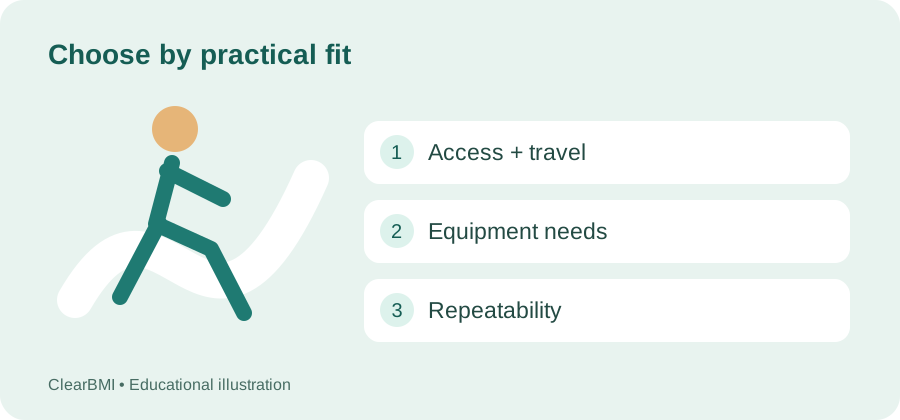
A 30-minute gym workout may require 20 minutes of travel each way. A home session avoids that travel but may involve interruptions or limited equipment. Write down the complete time commitment for both options before choosing. If you need specialist equipment or coaching, a gym may solve a real problem. If starting is the main obstacle, a small clear space at home may be enough. Try the option that fits your current schedule for two weeks, then review attendance and enjoyment rather than judging it by an idealized routine.
Keep reading: