
There's a meaningful difference between a plan that produces short-term results and a habit that lasts for years, and the difference has less to do with discipline than most people assume — it's mostly about how the habit was designed in the first place.
Start smaller than feels necessary
One of the most consistent findings in behavior change research is that habits with a very low barrier to entry are dramatically more likely to stick than ambitious ones. A goal of "a 5-minute walk every day" is far more likely to survive a busy or low-motivation week than "a 45-minute gym session every day," even though the latter sounds more impressive. Small, consistent actions compound over time in a way that occasional, exhausting bursts of effort don't.
Attach new habits to existing routines
Behavior change research often points to "habit stacking" — attaching a new behavior to an already-established one — as more effective than trying to build a habit around a "free" moment you have to remember and find each day. "After I pour my morning coffee, I'll do five minutes of stretching" is more reliable than a vague intention to "stretch sometime in the morning."
Design your environment, not just your intentions
Willpower is a limited and inconsistent resource; environment design tends to be far more reliable. Keeping vegetables pre-washed and visible in the fridge, keeping walking shoes by the door, or simply not keeping certain tempting foods in the house removes the need to rely on willpower at the exact moment it's weakest — typically when tired, stressed, or busy.
Track the habit, not just the outcome
Outcome measures like weight fluctuate for reasons unrelated to your actual behavior — water retention, hormonal cycles, digestion — which can be discouraging even when your habits are genuinely on track. Tracking the habit itself (did I take the walk today? did I include vegetables at lunch?) provides more immediate, controllable feedback than tracking an outcome that responds slowly and noisily. Our guide on tracking progress without relying only on the scale covers this in more depth.
Plan for the habit to break sometimes — and have a re-entry plan
Perfect adherence is not a realistic expectation over months and years; illness, travel, and busy periods will interrupt any habit eventually. The difference between people who maintain habits long-term and those who don't usually isn't the absence of interruptions — it's having a low-friction way to resume afterward, rather than treating a broken streak as a reason to abandon the habit entirely (sometimes called "the what-the-hell effect" in behavior research).
Expect a period before it feels automatic
Commonly cited research suggests habit formation can take anywhere from a few weeks to a few months, depending on the complexity of the behavior and the individual — considerably longer than the often-repeated "21 days" claim, which isn't well supported by the original research it's usually attributed to. Expecting a longer runway reduces the discouragement of a habit still feeling effortful after a few weeks.
Why this approach outperforms short-term diets
A restrictive short-term diet can produce results while it's being followed, but it typically doesn't include a plan for what happens afterward — which is a large part of why regained weight is such a common outcome after temporary, intensive approaches. Building genuinely sustainable habits, even smaller ones, front-loads the "what happens long-term" question rather than deferring it.
Getting started
Pick one small, specific habit — smaller than feels impressive — attach it to an existing routine, and give it a few months before judging whether it's "working." This approach is slower to show dramatic results than an intensive short-term plan, but it's considerably more likely to still be in place a year from now.
This article is educational and general in nature, not personalized medical or psychological advice.
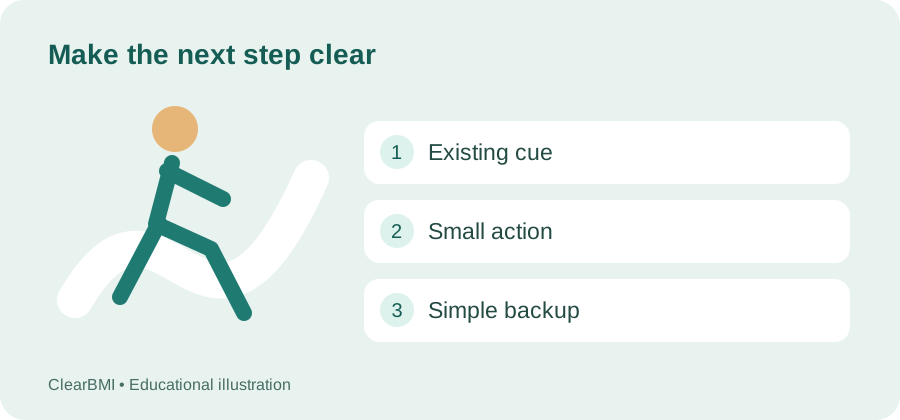
Write a cue and an action together
Instead of “exercise more,” write “after I put away my lunch plate, I will take a short walk.” Choose a small version that fits a difficult day and decide what you will do when the usual route is unavailable. Review whether the cue actually happens at a predictable time. If it does not, move the action to another part of the day. This is a planning experiment, not a test of character. Adjusting the setup is often more useful than demanding greater motivation from yourself.
Keep reading: